
Powerful Matthew 11:28 Meaning: Come to Me, All Who Labor
Matthew 11:28 is Jesus’s invitation to the exhausted and burdened: “Come to me, all who labor and are heavy laden, and I will give you rest.” It’s not a general comfort verse it’s aimed at people worn out specifically by the weight of religious rule-keeping.
What Does Matthew 11:28 Actually Mean?
Strip away the King James phrasing and the sentence is simple. Jesus is talking to tired people. Not tired from a long day at work, necessarily tired from trying to measure up. The word “labor” describes work that has already worn a person down, and “heavy laden” describes a load someone else piled on top of them. Put together, the verse says: stop carrying that weight alone, and bring it to me instead.
According to the ESV Study Bible’s notes on Matthew 11, the invitation follows a section where Jesus pronounces judgment on cities that saw his miracles and didn’t repent, then thanks the Father for revealing truth to “little children” rather than the intellectually “wise.” That sequence matters. Rest, in this verse, is promised to the humble not to the impressive.
Readers who search Matthew 11:28 during a hard week often want one thing: permission to stop performing. That’s basically what’s being offered here.
The Historical Context: Who Was Jesus Talking To?
Matthew 11:20-24 records Jesus rebuking Chorazin, Bethsaida, and Capernaum towns that watched him work miracles and shrugged. Verse 25 pivots hard: Jesus thanks God for hiding “these things” from the wise and revealing them to “little children.” Then, without a break in the text, he opens his arms to anyone who’s tired.
Kopiao is the Greek word behind “labor” (κοπιῶντες), and it means work to the point of exhaustion not casual effort. Most people assume “labor” here just means “work hard.” The text says something narrower: work that has already drained you dry.
What most guides skip is the audience. Jesus was speaking primarily to Jews living under the weight of Pharisaic legal interpretation a system Matthew 23:4 later describes as leaders who “bind heavy burdens… and lay them on people’s shoulders.” Some readers apply verse 28 broadly to any kind of modern stress, and that’s not wrong, exactly. But the original weight being described was religious, not just circumstantial.
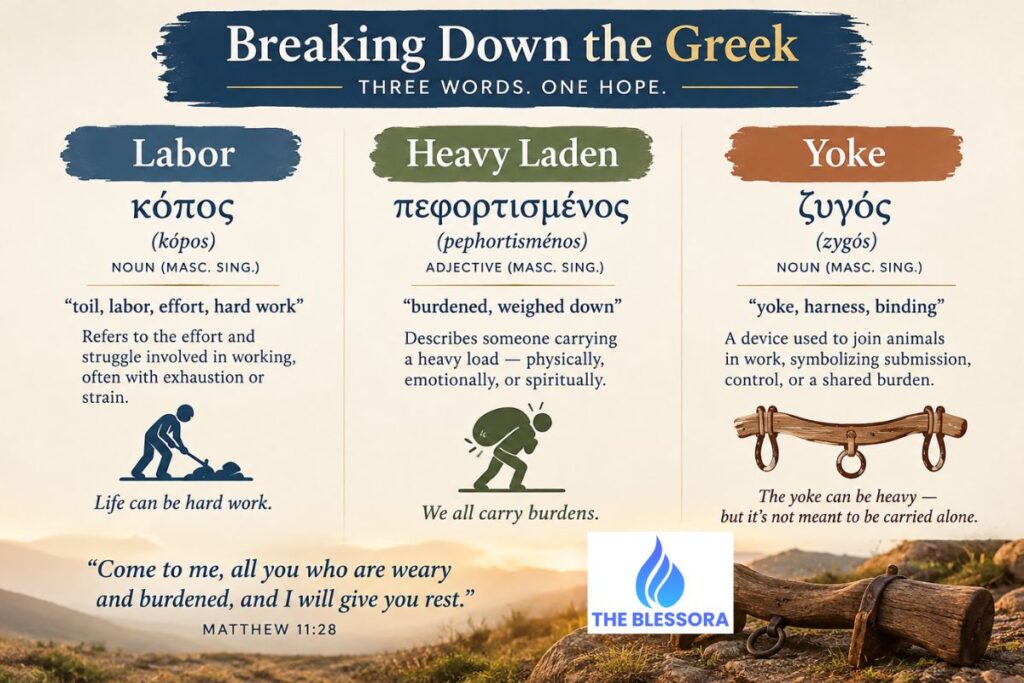
Breaking Down the Greek: “Labor,” “Heavy Laden,” and “Yoke”
Three Greek words carry the whole verse.
- Kopiao (labor) exhausting toil, used elsewhere in the New Testament for physical and spiritual weariness.
- Phortizo (heavy laden) to be loaded down, as with cargo. It’s passive; something was done to the person.
- Zygos (yoke) a wooden crossbar linking two oxen so they pull together.
Rabbinic teachers of Jesus’s era regularly spoke of the “yoke of Torah” or “yoke of the commandments” submitting to God’s law was described as taking on a yoke. Jesus doesn’t reject that image. He redefines it.
Yoke of the Pharisees vs. yoke of Jesus: the Pharisaic yoke, as taught by scribes who “bind heavy burdens,” added layers of oral tradition on top of Torah. Jesus’s yoke is better suited for the same basic commitment obedience to God because it’s paired directly with him doing the pulling. The key difference: one system asks you to carry alone; the other promises company.
Interestingly, a similar invitation shows up centuries earlier in Sirach 51, part of the Jewish wisdom literature, where personified Wisdom calls the unlearned to “put your neck under the yoke.” Scholars have long noted the parallel Jesus may be deliberately echoing, and correcting, that older invitation.
See More; 7 Swords of St Michael Prayer
KJV vs NIV vs ESV: Side-by-Side Comparison
The core meaning doesn’t shift much across translations, but word choice changes how the verse lands on a modern ear.
| Translation | Wording | Best For | Limitation |
|---|---|---|---|
| KJV | “labour and are heavy laden” | Traditional, memorization, hymn-language readers | Archaic phrasing can obscure meaning for newer readers |
| NIV | “weary and burdened” | Everyday reading, first-time Bible readers | Smooths over some of the Greek’s intensity |
| ESV | “labor and are heavy laden” | Study and word-for-word accuracy | Retains KJV cadence, so still slightly formal |
Quick Comparison: KJV preserves historic language rooted in Tyndale’s original translation. The NIV trades precision for accessibility. The ESV tries to hold both literal enough for study, readable enough for daily use.
How Matthew 11:28-30 Connects as One Invitation
Verse 28 doesn’t stand alone. It’s the first line of a three-part sentence that keeps going through verse 30.
To follow the full invitation, the passage moves in three steps:
- Come bring your exhaustion to Jesus directly.
- Take his yoke replace the old burden with a new one.
- Learn from him rest comes through ongoing relationship, not a one-time transaction.
Here’s the thing: most sermons quote verse 28 and stop, which turns “come to me” into a nice slogan instead of the start of a relationship. Verse 29 explains how rest actually arrives by learning from someone described as “gentle and lowly in heart.” Verse 30 closes the thought: “my yoke is easy, and my burden is light.” Easy doesn’t mean effortless. It means well-fitted, the way a properly built yoke doesn’t chafe an ox the way a poorly made one does.
How to Apply This Verse Personally Today
A verse like Matthew 11:28 gets read a lot on phones, mid-scroll, mid-crisis. That’s not a criticism it’s just where most people meet Scripture now. A 2023 American Bible Society report found regular self-directed Bible engagement has fallen to roughly one in five U.S. adults, even as mobile Bible-app usage keeps climbing. Verses get encountered one at a time, out of sequence, through search which is exactly how most people arrive at a page like this one.
Practically, that means three things. First, read verses 29-30 immediately after 28 don’t stop at the promise without reading the instruction that follows it. Second, ask what “burden” the verse might be naming in your own life right now; for many readers it’s not literal labor but pressure to perform, whether religious, professional, or relational. Third, if you’re using an app like YouVersion for daily reading, pair this verse with its immediate context rather than treating it as a standalone quote card.
I’ve seen Matthew 11:28 used two different ways online some sites treat it purely as an emotional comfort verse, others treat it purely as a rebuke of legalism. My read is it’s both, held together: comfort because the legalistic burden is being lifted, not instead of it.
Look if you’re in a season where faith feels like one more obligation on a long list, this verse is specifically for you. It’s not aimed at people who have it together.
FAQs
What’s the best translation of Matthew 11:28 for daily reading?
The NIV reads most naturally for daily use; the ESV or KJV suit closer word study.
How do I know if Matthew 11:28 applies to me?
If you feel worn out by trying to earn approval religious or otherwise the verse is addressed to you.
Why does Jesus mention a “yoke” instead of just saying “rest”?
Because rabbis of his time already used “yoke” for religious obligation; he’s reframing that existing image.
Should I read Matthew 11:28 by itself or with 29-30?
Read all three verses together 28 makes a promise that 29-30 explains and completes.
Conclusion
This page covers the meaning, Greek background, and translation differences of Matthew 11:28. It doesn’t cover the verse’s use in specific hymns or liturgical traditions that’s a separate study on its own.