What Is Blasphemy? Meaning, Origins, Religious Context
Blasphemy laws still exist in many countries today? This article explores what is blasphemy? Means, its origins, and how it affects various religions. Understanding this concept is crucial because it influences freedom of speech and religious beliefs around the world. By the end of this read, you’ll have a clearer picture of blasphemy and its role in modern society.
It really means to insult a sacred belief? What Is Blasphemy? Meaning, Origins, Religious Context dives into this fascinating topic. Blasphemy might seem like a heavy word, but it affects many lives today. You’ll discover its roots, what it means in different religions, and why it matters now more than ever.
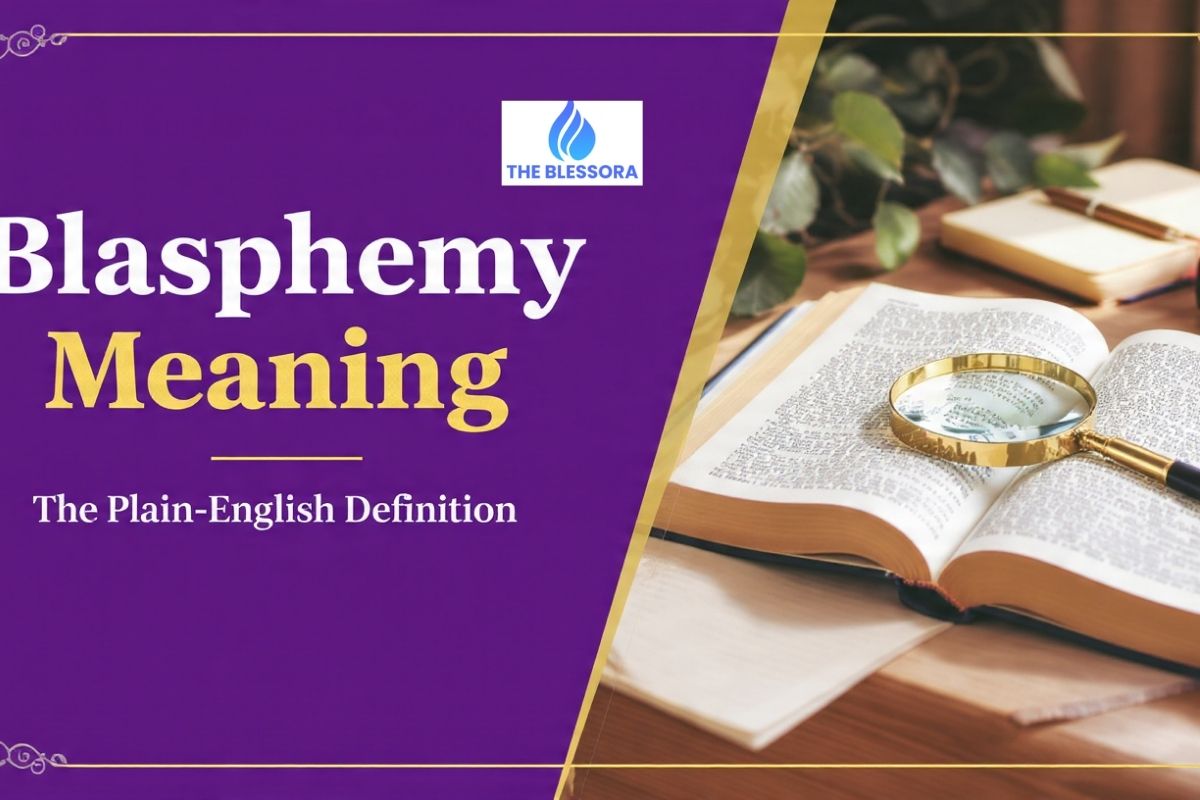
Blasphemy Meaning: The Plain-English Definition
Blasphemy is the act of showing contempt, insult, or irreverence toward God, a religion, or something considered sacred. It can take the form of speech, writing, images, or actions.
At its core, blasphemy is about disrespecting the sacred not just disagreeing with it. Two people can question whether God exists all day long and never commit blasphemy in the traditional sense; blasphemy usually implies mockery, insult, or profanity directed at something a community holds holy.
A simple working definition:
Blasphemy = treating something sacred (a deity, a prophet, a scripture, a religious symbol) with deliberate disrespect, mockery, or insult.
Blasphemy Definition by Origin (Etymology)
The word traces back to the Greek Disrespect, a combination of roots generally understood as “harm” and “speech” or “fame” essentially, speech that damages someone’s (or something’s) reputation. It entered Latin as blasphemia and Old French as Insult before arriving in English by the 13th century, already carrying its religious weight: speech that injures the honor of God.
That etymology matters because it explains why blasphemy has always been treated as more serious than ordinary insult. It isn’t just rude historically, it was considered an attack on the moral order itself.
Blasphemy vs. Sacrilege vs. Heresy vs. Apostasy
This is where most dictionary definitions stop short and where most people get confused. These four words all involve “religious wrongdoing,” but they are not interchangeable. Here’s how they differ:
| Term | What It Means | Example |
|---|---|---|
| Blasphemy | Insulting or showing contempt for God, a prophet, or something sacred, usually through speech, writing, or images | Mocking a religious figure in a cartoon or comedy routine |
| Sacrilege | Violating or showing disrespect toward a sacred object, place, or ritual | Stealing from a temple, desecrating a grave, vandalizing a church |
| Heresy | Holding or teaching a religious belief that contradicts official church/religious doctrine, while still claiming to belong to that faith | A church member publicly rejecting a core doctrine, like the Trinity |
| Apostasy | Formally abandoning or renouncing one’s religion altogether | Someone raised Muslim or Christian who converts to another faith or to atheism |
A quick way to remember the difference: blasphemy insults, sacrilege desecrates, heresy contradicts doctrine from inside the faith, and apostasy leaves the faith entirely. They often overlap in real cases a single act (like publishing a controversial book) can be labeled blasphemous by one group and heretical by another, depending on who’s doing the judging.
Blasphemy in Religious Context
Blasphemy isn’t defined the same way across religions. What counts as blasphemous, and how seriously it’s treated, depends heavily on the tradition.
Also See : Flirty Good Morning Texts
Blasphemy in Christianity
In Christian theology, blasphemy traditionally refers to speech that denies God’s power, mocks Jesus Christ, or shows contempt for the Holy Spirit. The Bible references “blasphemy against the Holy Spirit” as a uniquely serious sin (Mark 3:29). Historically, European Christian societies from medieval England to colonial America criminalized blasphemy, and punishments ranged from fines to execution. Most Western countries have since repealed or stopped enforcing these laws, treating blasphemy today as a matter of private conscience or, at most, social offense rather than crime.
Blasphemy in Islam
In Islamic tradition, blasphemy (sometimes discussed alongside the Arabic term sabb, meaning insult) generally covers insulting Allah, the Prophet Muhammad, the Quran, or core tenets of Islam. Unlike in most modern Christian-majority countries, blasphemy remains a serious criminal offense in a number of Muslim majority nations, with penalties in some jurisdictions including lengthy imprisonment or death. This is the single biggest reason “blasphemy” still appears in international news today.
Blasphemy in Judaism
In Jewish law, blasphemy historically referred specifically to cursing or reviling the name of God (Chillul Hashem, or profaning God’s name, is a related but broader concept). Traditional Jewish law treated blasphemy as an extremely serious offense, though in practice, modern Jewish communities like most Christian ones no longer pursue legal punishment for it.
Secular and Non-Religious Views
Outside religious frameworks, blasphemy is often reframed as a free-speech issue rather than a moral one. Secular societies generally protect the right to criticize, mock, or reject religious ideas as an extension of freedom of expression even when that speech is deeply offensive to believers. This is the core tension behind nearly every modern blasphemy controversy: one side sees an attack on the sacred; the other sees the exercise of a basic right.
Blasphemy Laws Today: Where They Still Exist
Blasphemy might sound like a medieval concept, but it’s very much a modern legal reality. A widely cited 2019 Pew Research Center analysis found that roughly 40% of the countries and territories studied 79 out of 198 had laws or policies penalizing blasphemy in some form, ranging from fines to the death penalty.
Blasphemy Law in Pakistan
Pakistan has some of the strictest blasphemy laws in the world, codified in Sections 295 to 298 of its Penal Code. Section 295-C, specifically, criminalizes derogatory remarks against the Prophet Muhammad and carries a mandatory death sentence upon conviction. These laws don’t just exist on paper they’ve shaped real political violence. In 2011, Salman Taseer, then governor of Punjab, was assassinated by his own bodyguard after he publicly called for reform of the blasphemy law and defended a Christian woman sentenced to death under it. His killer was later celebrated by supporters as a hero rather than condemned as a murderer a stark illustration of how deeply blasphemy laws can divide a society.
Blasphemy Law in the UK, Europe, and the US
Most Western democracies have moved away from enforcing blasphemy laws. The United Kingdom formally abolished its common-law blasphemy offense in 2008. The United States has never had a federal blasphemy law, and the First Amendment makes most such laws unconstitutional at the state level. Some European countries, like Ireland, only removed blasphemy from their criminal code in the last decade (Ireland repealed its constitutional blasphemy offense following a 2018 referendum). A handful of European nations still technically retain blasphemy-adjacent laws (often framed as “religious insult” or “hate speech” statutes), though enforcement is rare.
Real-World Examples What is Blasphemy? Meaning
Abstract definitions are one thing seeing how blasphemy plays out in the real world makes the concept click.
- Salman Rushdie’s The Satanic Verses (1988): The novel was accused of blaspheming Islam and the Prophet Muhammad, prompting Iran’s Ayatollah Khomeini to issue a fatwa calling for Rushdie’s death. The controversy triggered book burnings, bans in multiple countries, and violence against translators and publishers and, decades later, a near-fatal attack on Rushdie himself in 2022.
- The Danish Muhammad cartoons (2005): A Danish newspaper’s publication of cartoons depicting the Prophet Muhammad sparked global protests, diplomatic crises, and violence, reigniting worldwide debate over the limits of free expression versus religious respect.
- Blasphemy accusations under Pakistan’s Section 295-C: Numerous individuals including religious minorities have been charged, imprisoned, or killed by mobs following blasphemy accusations, often before any formal trial concludes, highlighting how the law can be weaponized in personal or communal disputes.
Blasphemy vs. Free Speech: The Modern Debate
The central argument today isn’t really about defining blasphemy it’s about whether it should be a crime at all. Supporters of blasphemy laws argue that:
- Religious belief deserves legal protection from deliberate insult, especially in diverse societies where mockery can incite real violence.
- Some communities view their sacred figures and texts as inseparable from their identity and dignity.
Critics of blasphemy laws argue that:
- Free expression, including the right to criticize or reject religious ideas, is a foundational human right.
- Blasphemy laws are frequently misused to settle personal scores, silence religious minorities, or suppress political dissent (as seen in many Pakistani blasphemy cases).
- International bodies like the UN Human Rights Committee have expressed concern that blasphemy laws are often incompatible with international free-speech standards.
There’s no global consensus and that’s exactly why the word “blasphemy” keeps resurfacing in news cycles, court cases, and campus debates decades after most people assumed it was a relic of the past.
Quick Recap: Blasphemy at a Glance
- Definition: Speech, writing, or actions that show contempt or insult toward God, a religion, or something sacred.
- Origin: From the Greek blasphēmia, meaning harmful or damaging speech.
- Related but different terms: Sacrilege (desecrating sacred objects/places), heresy (contradicting doctrine from within a faith), apostasy (leaving a faith entirely).
- Religious variation: Treated differently in Christianity, Islam, and Judaism, both theologically and legally.
- Modern reality: Still criminalized in roughly 40% of countries worldwide as of the 2019 Pew Research Center study, with Pakistan’s Section 295-C among the most severe.
- Core tension: Religious dignity versus freedom of expression a debate playing out in courts, parliaments, and public squares today.
Frequently Asked Questions
Is blasphemy illegal everywhere?
No. Roughly 40% of countries studied by Pew Research have some form of blasphemy law, but enforcement and severity vary enormously from small fines in some countries to the death penalty in others. Many Western nations have repealed their blasphemy laws entirely.
What’s the difference between blasphemy and hate speech?
Blasphemy specifically targets the sacred God, prophets, scripture, religious symbols. Hate speech is a broader legal category targeting speech that incites violence or discrimination against people based on protected characteristics, which can include religion but isn’t limited to it.
Can blasphemy happen accidentally?
Under most religious definitions, blasphemy implies some level of intent or contempt. However, in countries with strict blasphemy laws, accusations don’t always require proof of intent, which is part of why these laws are controversial in practice.
Is questioning religion the same as blasphemy?
Not necessarily. Respectful disagreement, doubt, or theological debate is generally distinct from blasphemy, which usually involves mockery, insult, or deliberate disrespect rather than sincere inquiry.
Conclusion
Blasphemy is a complex topic with deep roots in various religions and cultures. The meaning of blasphemy can vary widely, from disrespecting holy figures to speaking against sacred beliefs. Understanding its origins helps us grasp why it is viewed so seriously in many communities. Today, laws around blasphemy differ greatly from country to country.
Blasphemy touches on important issues of faith and freedom. Its definition can change based on culture and context, which makes it a fascinating subject to explore. Knowing its history and how it’s treated in today’s laws allows us to see the bigger picture.