10+Daily Prayer: A Simple Habit and Guide to Praying Every Day
You know you should pray every day. You’ve probably tried an app, a challenge from someone you follow online, a promise to yourself after a rough week. And then life happened, and it quietly stopped.
You’re not failing at Daily prayer. You’re missing a structure simple enough to survive a busy Tuesday. That’s what this guide gives you: a repeatable framework you can use starting today, plus short prayers for the moments that actually show up in your day mornings, anxiety, before work, and parenting.
Why Daily Prayer Feels Harder Than It Should

Most people don’t quit praying because they stop believing in it. They quit because their approach depends on motivation, memory, or a perfect quiet moment and none of those show up reliably.
A devotional app works for a week, then becomes one more notification you swipe away. “Praying whenever I think of it” sounds flexible but rarely becomes a habit, because habits need a cue, not a mood. A 7-day challenge builds momentum, then ends on day 8 with nothing to replace it.
If any of that sounds familiar, the problem isn’t your discipline. It’s that you’ve never had a structure simple enough to repeat without thinking too hard about it.
You’re also not alone in wanting this consistency. Research from the Pew Research Center’s 2023–24 Religious Landscape Study, published in February 2025, found that 44% of U.S. adults say they pray at least once a day a figure that has held steady between 44% and 46% since 2021. Daily prayer is a common goal; a workable routine is the missing piece for most people trying to build it.
The Simple Structure: ACTS Prayer Framework

Single daily devotionals the kind you’ll find on sites like Crosswalk or Sacred Space give you something to read today. But tomorrow, you’re back to needing another one. What you actually need is a framework you can reuse indefinitely, with or without an app or article to guide you.
The one worth learning is ACTS: Adoration, Confession, Thanksgiving, Supplication. It’s old, simple, and flexible enough to take two minutes or twenty.
- Adoration Start by acknowledging who God is, separate from what you need from Him. One sentence is enough: “You are good. You are in control.”
- Confession Be honest about where you fell short today or yesterday. No need for a long list naming one thing is more sustainable than trying to be exhaustive.
- Thanksgiving Name something specific you’re grateful for. Specific beats general: “my coworker covered for me today” lands more than “thank you for everything.”
- Supplication Ask. For yourself, for people you love, for the situation in front of you. This is the part most people jump to first ACTS just asks you to put it last, after you’ve slowed down.
You don’t need to write this out or follow it word for word. Once you know the four movements, you can move through them in your head while walking to the car or lying in bed. That’s the whole point it’s a shape for your attention, not a script you have to perform.
How to Start a Daily Prayer Habit That Actually Sticks
The habit fails when it depends on remembering. It holds when it’s attached to something you already do without thinking.
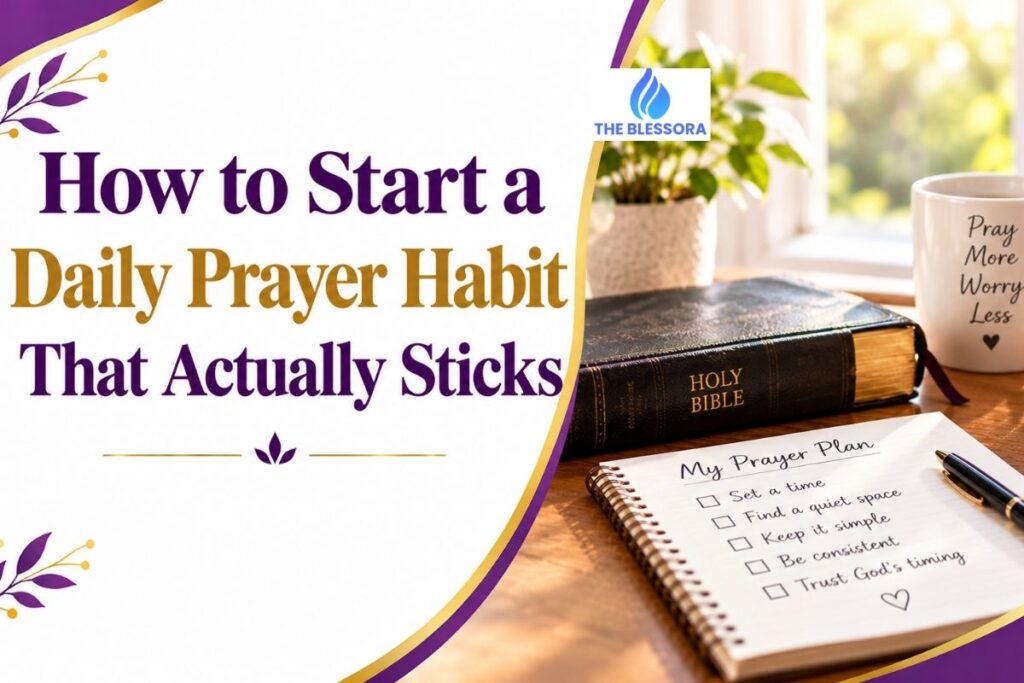
- Pick an anchor, not a time. “I’ll pray at 7am” competes with a hundred other 7am plans. “I’ll pray while the coffee brews” or “I’ll pray after I put my phone on the charger at night” attaches prayer to something that already happens daily.
- Cap it at two minutes to start. Not because longer is bad, but because a two-minute habit gets repeated and a twenty-minute one gets postponed. You can always stay longer once you’re there.
- Use the same structure every time. This is where ACTS earns its place familiarity removes the friction of deciding what to pray, which is often the real reason people stall out.
- Let the first week be rough. A repeated, imperfect prayer beats an eloquent one you only say once. Consistency is the goal, not sophistication.
- Decide what happens when you miss a day. You will. The habit doesn’t need a perfect streak it needs a plan for tomorrow morning that doesn’t involve guilt.
A Simple Morning Prayer Routine
Mornings work well as an anchor because the day hasn’t filled up yet. Here’s a version you can use tonight to try tomorrow:
“God, thank You for this new day. I don’t know everything it holds, but You do. Help me notice You in it in the ordinary parts, not just the hard ones. Where I’m anxious, steady me. Where I’m distracted, focus me. I bring you [name one specific thing on your mind]. Go ahead of me today. Amen.”
That’s roughly thirty seconds spoken slowly. It covers adoration (“You do”), a light confession (“where I’m distracted”), thanksgiving (“thank You for this new day”), and supplication (the specific thing) ACTS, compressed into something you can say while the kettle boils.
See More: Everything Happens For A Reason
Short Daily Prayers for Specific Moments
A single morning prayer won’t cover a whole day. These four are short enough to say silently, anywhere.

When you’re anxious:
“God, I don’t have control over this, and I’m carrying it like I do. I’m putting it down. Be near to me in this specific worry. Give me the next right step, not the whole picture.”
Before work or a hard conversation:
“God, give me clarity for what’s ahead. Help me be honest and calm, not reactive. If I need patience today, give it to me before I need it, not after I’ve already lost it.”
With kids, or in a chaotic house:
“God, thank You for this noise it means they’re here and healthy. Give me patience for the next hour, not the whole week. Help me see one moment today where I can be fully present instead of just managing.”
Before sleep:
“God, thank You for today, the good and the hard parts of it. I release what I couldn’t fix. Watch over the people I love while I rest. Tomorrow can wait until tomorrow.”
Say these as written the first few times, then let them loosen into your own words. The goal isn’t memorization it’s having something ready so you’re not starting from a blank page every time.
Tools That Can Help (Without Becoming the Point)
An app can support the habit, but it shouldn’t replace the habit itself that’s usually why the app gets deleted after a week. Used as scaffolding rather than a requirement, a few are genuinely useful:
- Lectio 365 a free daily prayer app built around morning and evening rhythms, good if you want scripture woven into a short guided prayer.
- Hallow a Catholic prayer and meditation app with guided sessions, useful if you respond better to an audio voice walking you through it than to silent, self-led prayer.
- The Book of Common Prayer for anyone who wants a more structured, liturgical form of daily prayer with set morning and evening offices, this centuries-old text is still one of the most complete templates available.
Try one for a week if a guide helps you get started. But the ACTS structure above works with no app at all, which matters on the days your phone is dead or you just don’t want another screen.
Also See Related: Good Night Messages
Frequently Asked Questions
How long should a daily prayer be?
Long enough to mean it, short enough to repeat. Thirty seconds to two minutes is a realistic starting length you can extend it once the habit itself is solid.
What if my prayers feel repetitive?
Repetition isn’t the enemy of sincerity it’s often what allows sincerity to survive a busy week. Structure like ACTS gives you a repeatable shape while what you actually name inside it changes daily.
What’s the best time of day to pray?
Whichever time you’ll actually keep. Morning works for many people because the day hasn’t filled up yet, but an anchor tied to an existing habit coffee, commute, bedtime matters more than the clock time itself.
Do I need to kneel, close my eyes, or say it out loud?
No. Posture can help focus, but none of it is required. A prayer said silently with your eyes open on a bus counts.
What if I miss a day?
You pray again the next day. A missed day breaks a streak, not the habit the only version of this that fails is the one where a missed day becomes a missed month because you decided you’d already blown it.
Conclusion
Daily prayer doesn’t need to be complicated to be real. Pick one anchor point today, use ACTS or one of the short prayers above, and let it be short enough that you actually do it tomorrow too. That’s the whole habit repeated, not perfected.